The relay outputs are located on the terminals marked with the schematic mark of the switch, they are used to switch two-state devices and can switch AC or DC voltage. The COM terminal is typically common, the voltage is then at the NO or NC terminal, depending on the relay state.
NO - in the default state (no voltage), contacts are open
NC - in the default state (no voltage), contacts are closed
The state (On/Off) of each relay is indicated by a LED with a corresponding label. Overload and overvoltage protection should be provided externally by a circuit breaker (ideally one for each output). Nominal current and circuit breaker type should be selected according to the load and its characteristics concerning the maximum current on the output.
Attention:
If an inductive load is connected (e.g., electric motors, relay coils, contactors, or even the cables in extensive electric installations), it is necessary to protect the relay outputs with a corresponding external element (e.g., varistor, RC circuit or a suitable diode).
If a capacitive load is connected (e.g., power sources of LED lights), it is necessary to protect the relay contacts against inrush current by connecting a corresponding thermistor to the relay's output.
Unipi 1.1
Connection
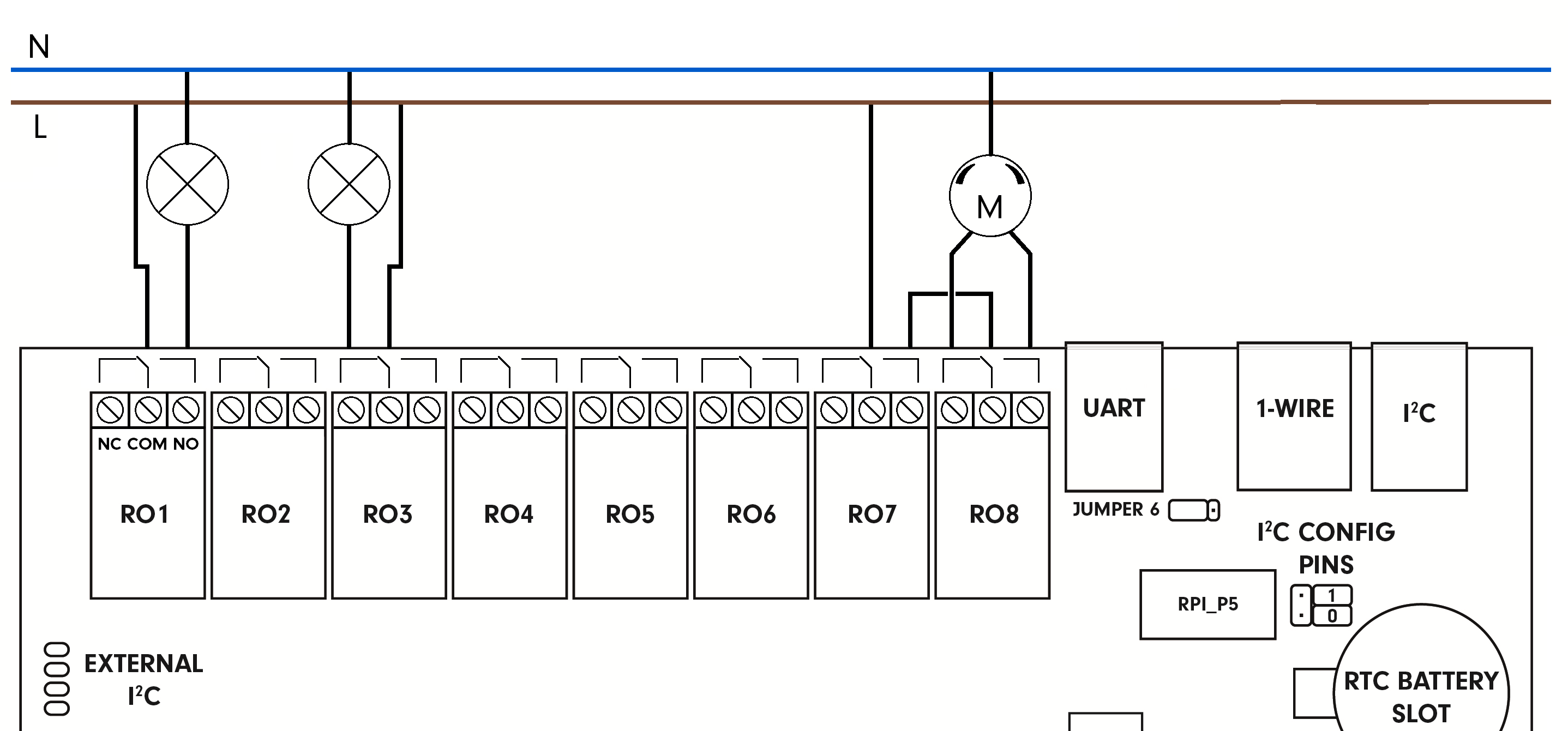
The following image depicts the connection of ohmic (resistance)load with alternating voltage and connection of a three-way valve to Unipi 1.1 relay outputs:
Technical parameters
The data below represent a selection of the most important parameters and serve only as a quick reference.
Detailed information can be found in the product datasheet provided by the relay manufacturer: Finder 36.11.9.005.4011
Output type
Electromechanic non-shielded relay
Designation on the board
RELAYx (where x represents the relay number)
Number of terminals per relay
3
Terminal designation
Schematic (on the board)
Common terminal (COM)
Middle terminal
Closed without voltage (NC)
Terminal engaged according to scheme
Open without voltage (NO)
Terminal disengaged according to scheme
Contact/Output type
Switchable NO/NC (SPDT)
Number and type of relays
8 × Finder 36.11.9.005.4011
Switching voltage
250 V AC
30 V DC
Max. switching current (resistive load)
10 A
Mechanical lifetime
10 000 000
Electrical lifetime
Up to 50 000 (according to the connected load)
Switching time
10 ms / 5 ms
Designed for load character
Resistive
Load handling
External (RC, varistor, diode, thermistor)
Short circuit protection
No
Overvoltage protection
No
Galvanic isolation
Yes
Insulation voltage
4 000 V
Unipi 1.1 Lite
Connection
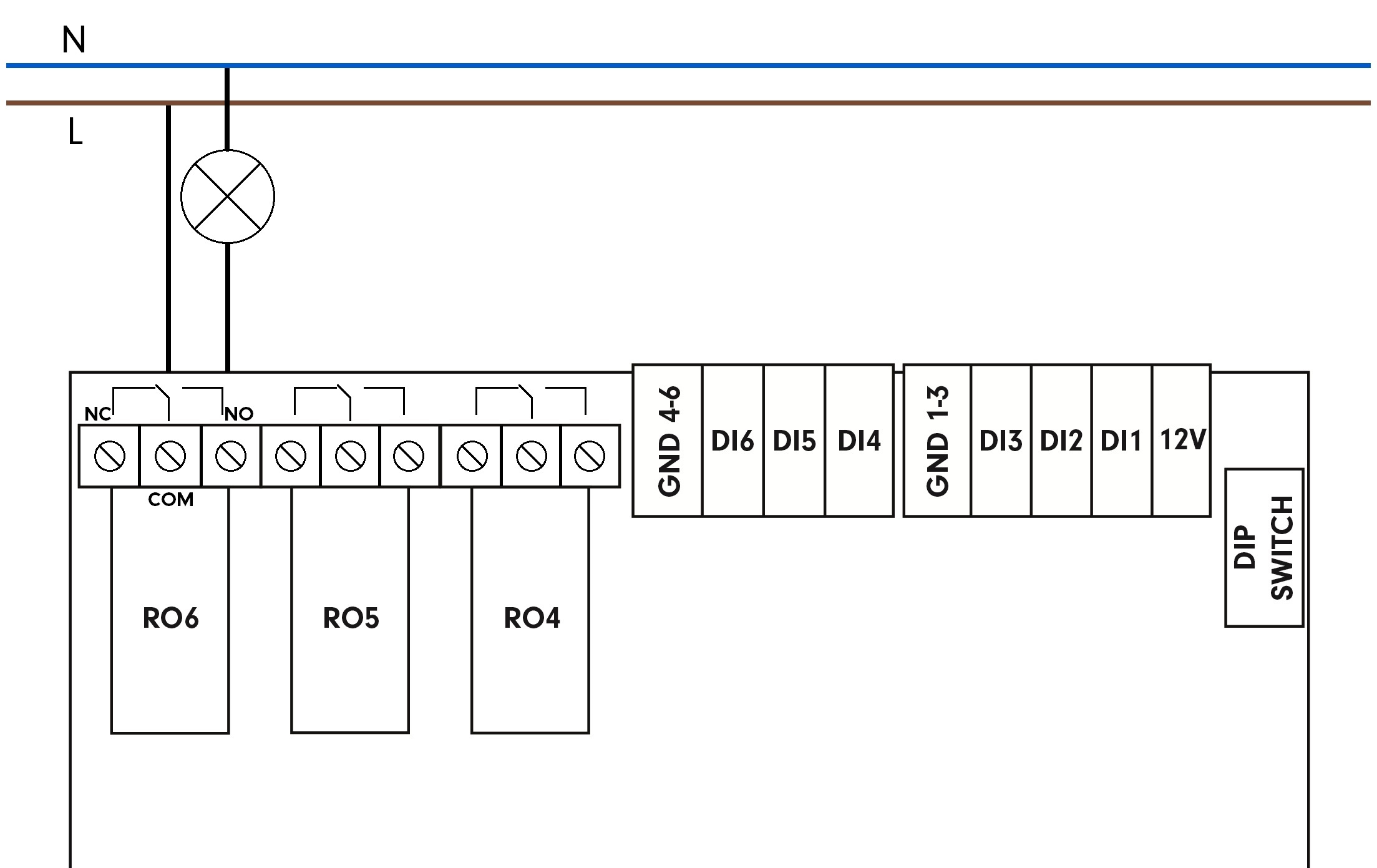
This illustration depicts connection of ohmic (resistance) load with alternating voltage to Unipi 1.1 Lite relay output:
Technical parameters
The data below represent a selection of the most important parameters and serve only as a quick reference.
Detailed information can be found in the product datasheet provided by the relay manufacturer: Omron G5Q-14-EU
Output type
Electromechanic non-shielded relay
Designation on the board
RELAYx (where x represents the relay number)
Number of terminals per relay
3
Terminal designation
Schematic (on the board)
Common terminal (COM)
Middle terminal
Closed without voltage (NC)
Terminal engaged according to scheme
Open without voltage (NO)
Terminal disengaged according to scheme
Contact/Output type
Switchable NO/NC (SPDT)
Number and type of relays
6 × Omron G5Q-14-EU
Switching voltage
250 V AC
24 V DC
Max. switching current for VAC
10 A (NO)
3 A (NC)
Max. switching current for VDC
5 A (NO)
3 A (NC)
Mechanical lifetime
10 000 000
Electrical lifetime
Up to 100 000 (according to the connected load)
Switching speed
10 ms / 5 ms
Minimum time between closing and opening
200 ms
Designed for load character
Resistive
Load handling
External (RC, varistor, diode, thermistor)
Short circuit protection
No
Overvoltage protection
No
Galvanic isolation
Yes
Insulation voltage
4 000 V
This website uses cookies. By using the website, you agree with storing cookies on your computer. Also you acknowledge that you have read and understand our Privacy Policy. If you do not agree leave the website.More information about cookies


 Detailed information can be found in the product datasheet provided by the relay manufacturer: